
What Is Enough? How Philanthropy Begins with Defining Wealth, Purpose and Giving
Amit and Archana Chandra on why defining "enough" may be one of the most important decisions in philanthropy—and how giving long before wealth shaped their lifelong commitment to social impact.
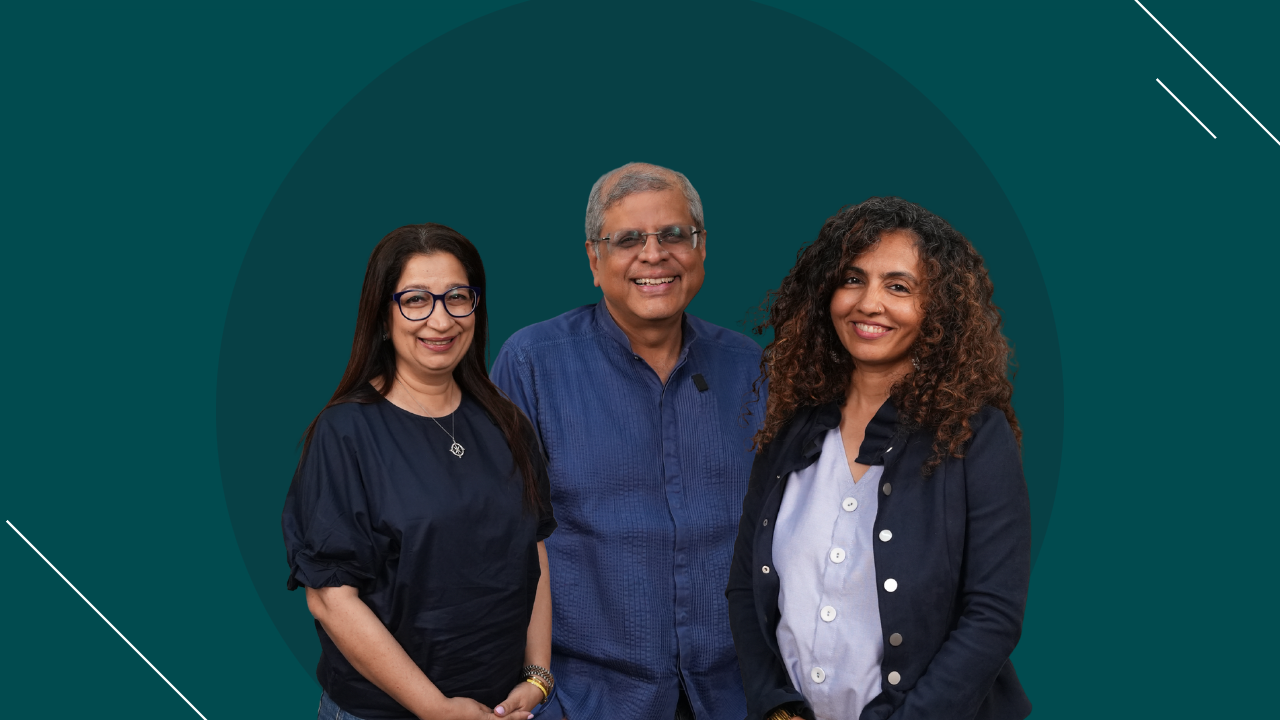



Key Takeaways:
- Giving is a habit, not a milestone. Mr. Amit and Ms. Archana Chandra began supporting scholarships when their combined monthly salary was just Rs.17,000, showing that generosity is shaped more by values than by wealth.
- Defining "enough" can be one of life's most liberating financial decisions. Rather than allowing lifestyle to expand endlessly with income, they consciously decided what their family genuinely needed before dedicating the rest towards creating social impact.
- Chuck Feeney's philosophy of "Giving While Living" transformed their approach to philanthropy.
What is enough? It is a simple question. Yet very few of us ever stop to ask it.
India is creating wealth at an unprecedented pace. According to the UBS Global Wealth Report 2025, the country is now home to nearly 917,000 US dollar millionaires, with around 39,000 added in a single year. Yet prosperity has grown alongside inequality. The World Inequality Report 2022 estimates that the richest 10% of Indians account for more than 57% of national income, while the top 1% alone receives around 22%.
As wealth grows, another question becomes more important—not simply how much can we accumulate, but what do we want our wealth to do?
For Mr. and Ms. Chandra, that journey began with one deceptively simple idea. "It's very easy to define what is enough. The problem is, we never ask ourselves this question." Recalls Mr. Chandra.
Many people assume philanthropy begins after financial success. We tell ourselves that we will start giving once we've ‘made it in life’.
The Chandras chose a different path. More than three decades ago, when they married, their combined monthly income was just Rs. 17,000. They lived as paying guests in the city of dreams and had very little disposable income. Yet even then, they were contributing towards scholarships. For Mr. Chandra, the decision was deeply personal. Scholarships had helped him pursue his own education. Giving back completed this circle.
Reflecting on those early years, he says: "We realised that we were what we were because of the generosity of others. However much you make, you can always give. Giving never makes you poorer. It only makes you richer."
Ms. Chandra's honesty about arriving at her own definition of ‘enough’ didn't happen overnight. Like many people, she was thinking about practical responsibilities: buying a home in Mumbai, raising a family, supporting ageing parents, planning for healthcare, creating financial security and allowing room for travel and life's small aspirations.
Rather than dismissing them in the name of philanthropy, Mr. Chandra encouraged her to write every one of them down. Together, with the help of a financial adviser, they created an Excel spreadsheet listing everything their family genuinely needed—housing, education, healthcare, family commitments and future security.
Ms. Chandra remembers: "Whatever it was that was an area of concern for me, we put on that spreadsheet." That exercise became a turning point and an act of clarity. Once the calculations were complete, Mr. Chandra doubled the estimated amount and transferred it into her account. The rest could be directed towards philanthropy.
One book profoundly influenced the Chandras' thinking: The Billionaire Who Wasn't, the biography of American philanthropist Chuck Feeney.
Feeney, co-founder of Duty Free Shoppers, built a fortune estimated at around billions before making one of the most extraordinary decisions in modern philanthropy. Rather than leaving his wealth behind, he chose to give away virtually all of it during his lifetime—and for many years, largely anonymously.
Through The Atlantic Philanthropies, he invested in universities, public health systems, scientific research, peacebuilding, ageing, education and human rights across the world. By the time the foundation closed in 2020, it had distributed more than US$8 billion, fulfilling Feeney's belief that wealth should create impact while its creators are still alive to witness, learn from and strengthen that impact. His philosophy became known globally as "Giving While Living."
For Mr. Chandra, reading Feeney's story was transformative. "I read that book and said, 'Wow. If he can do this, I think we can.'" The Chandras often describe their values as being shaped by two powerful influences. One came from Guru Nanak's teaching of "Kirat Kar, Vand Chhako"—earn honestly and share what you have. The way came from Chuck Feeney's example.
Ms. Chandra's perspective emerged from a quieter, deeply personal place. Her grandmother often repeated a saying she still carries with her: "Neki kar aur kuye mein daal."
Do good and forget about it
Many people still associate philanthropy with charity and writing cheques. The Chandras see it differently. Through the A.T.E. Chandra Foundation (ATECF), they focus on strengthening institutions rather than funding isolated projects. Their work centres on two broad priorities: improving water security and climate-resilient agriculture and building the capacity of nonprofit organisations across India. That philosophy also extends to Ms. Chandra's leadership of Jai Vakeel Foundation, one of India's oldest organisations supporting children and adults with intellectual and developmental disabilities, where long-term care, inclusion and institutional excellence remain central to the organisation's work.
This reflects a broader shift taking place across global philanthropy. Increasingly, funders recognise that lasting social impact depends not only on supporting programmes, but also on strengthening the institutions and ecosystems behind them.
The Chandras' story is ultimately not about giving money away. It is about gaining clarity—about recognising that financial security and philanthropy are not competing goals, but complementary ones.