
The Foundation Betting on Both AI and the Humanities
Inside the philanthropy of Harish and Bina Shah — a look at how education, healthcare, arts, and social impact all find a place in one diverse giving portfolio.
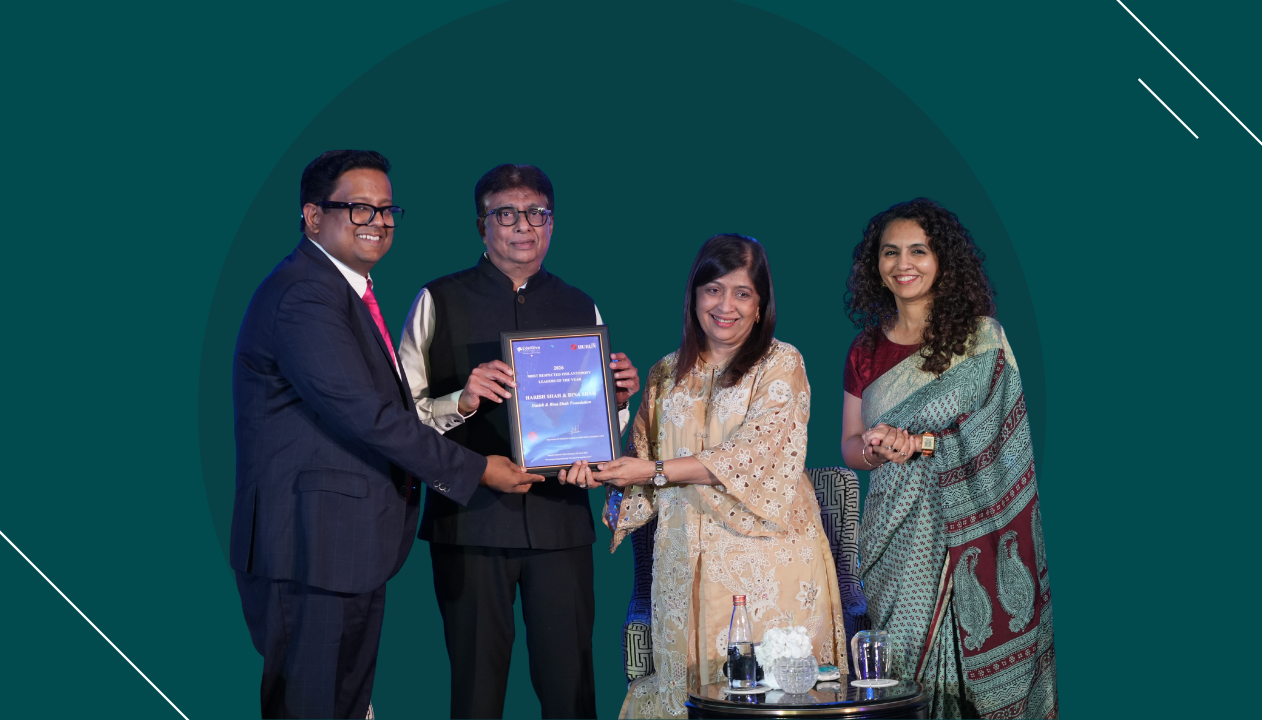



Key takeaways:
- Two schools, one thesis — HBSF backs Plaksha's Harish and Bina Shah School of AI & Computer Science and Ashoka's Harish and Bina Shah School of Humanities, betting that technology and humanistic inquiry advance together, not apart.
- A foundation built over two decades — what began as personal giving in the early 2000s formalised into HBSF, now active across education, health, livelihoods, arts and culture, legal aid, and more.
- Geography and sector agnostic — the Shahs say the real filter isn't where or what a cause is, but the quality of the people and organisation behind it.
A school of Artificial Intelligence (AI) and Computer Science in a university in Punjab. A school of humanities studies in a university in the National Capital Region. And one philanthropic foundation behind both.
It's a telling pairing. At a time when much of public discourse pits humanities against AI, this is evidence of how Harish and Bina Shah see the two — not as rivals, but as complementary forces for progress, neither complete without the other.
This intuition and foresight is a hallmark of their philanthropic portfolio.
Inaugurated in 2025, the Harish and Bina Shah School of AI & Computer Science at Plaksha brings together AI, computer science, and global partnerships, including one with the University of Pennsylvania.
Founded a year earlier, in 2024, the Harish and Bina Shah School of Humanities at Ashoka University spans disciplines from History and Philosophy to Media Studies and the Performing Arts, shaping thoughtful, socially engaged leaders.
Between the two lies the Shahs’ central bet: that technology without context is hollow, and context without technology is limited — and that real progress demands both.
Two Decades in the Making
The Harish & Bina Shah Foundation (HBSF) traces its roots to the early 2000s, when Harish and Bina Shah began supporting initiatives that expanded access to education, healthcare, and sustainable livelihoods. Over time, personal philanthropy evolved into enduring partnerships with grassroots organisations, and eventually into a formal foundation.
Today, HBSF supports social change across education, health, livelihoods, arts and culture, legal aid, environmental sustainability, and economic reform — guided, the Shahs say, by compassion, responsibility, and long-term commitment. The foundation was established by Harish and Bina Shah alongside founding members Amira Shah Chhabra, Anushka Shah, Robin Chhabra, and John Firth, bringing together family-led philanthropy, leadership, and development expertise to drive long-term social impact.
Speaking with EdelGive Foundation CEO Naghma Mulla, Harish Shah explained how the foundation evaluates a cause: the people behind it, their capacity, and their leadership. “Ashoka was a no-brainer,” he said. “When we went there and saw what they had already achieved… in venture capital terms, we did not come in at seed funding, we came in at Series C and ahead of that. It’s up and running, and it’s beautiful, and you need to support this cause.”
Yet the portfolio’s real signature, Mulla pointed out, is how the Shahs invest where the need is greatest — including as a later-stage funder in the GROW Fund, anchored by EdelGive Foundation, stepping in precisely where support was most needed.
“From small, we are also now looking at different kinds of programs — small, medium to big — that’s what we have in our portfolio,” said Bina Shah.
“We also invest in areas that are completely ignored,” added Harish Shah. “We do a lot in art and culture — we’re restoring a museum in Mysore, and there are other conservation projects we’re looking at.
“We believe society has to evolve, so you have to move in tandem — you cannot move on just one part,” he said. “You look at the top level and think that’s the problem. That’s not the problem. There are many underlying causes. When you look for solutions, you have to go deeper into the story.”
Knowing Where — and When — to Say Yes
Asked how the foundation decides where to invest — from cutting-edge AI to grassroots healthcare — Harish Shah pointed to fundamentals. “The starting point is really how good the organisation is: are the people well-meaning and productive, do they want to do things, what is the sustainability model. You have to check out the basics first.”
The foundation, he said, is deliberately geography- and sector-agnostic. He cited Dr. Ravi Kannan, a surgical oncologist and Padma Shri and Ramon Magsaysay awardee, as an example of the kind of commitment that draws their support. Kannan moved to Silchar, Assam, in 2006 after witnessing the barriers cancer patients faced in accessing treatment, and as Director of the Cachar Cancer Hospital & Research Centre, helped grow a 20-bed facility into a major centre for affordable, dignified cancer care.
“That man starts work at 7 a.m. and goes to bed at 11 — and if an emergency happens at 11:30, he goes back to the hospital. He lives in the hospital. A very simple, down-to-earth man. His only purpose in life is to save that kid, that mother, that father — whoever it is. That’s all he does,” Harish Shah said.
On when to begin giving, Bina Shah was direct: “You should start early — definitely.” She recalled a senior colleague, Mr. Mascarenhas, who joined the company after retiring. When the company hit its first major target, he told them plainly: “Harish and Bina, now is the time to share this — let’s do something.”
Looking back, Bina Shah described the foundation’s evolution as a continuing education. “We are still learning, relatively — even though we are very close to our 70s. We are very young in this sector, I feel. There are so many pioneers, so many people whose shoes are difficult to fill. We learn a lot from others.”