
Strong Institutions vs Strong Intentions: What Amit and Archana Chandra Teach Us About Sustainable Philanthropy
In philanthropy, projects often get the attention. Institutions create the impact. In a candid conversation on Give It A Go, Amit and Archana Chandra reflect on why building strong organisations, trusted leaders, and resilient ecosystems may be one of the most important investments philanthropists can make.
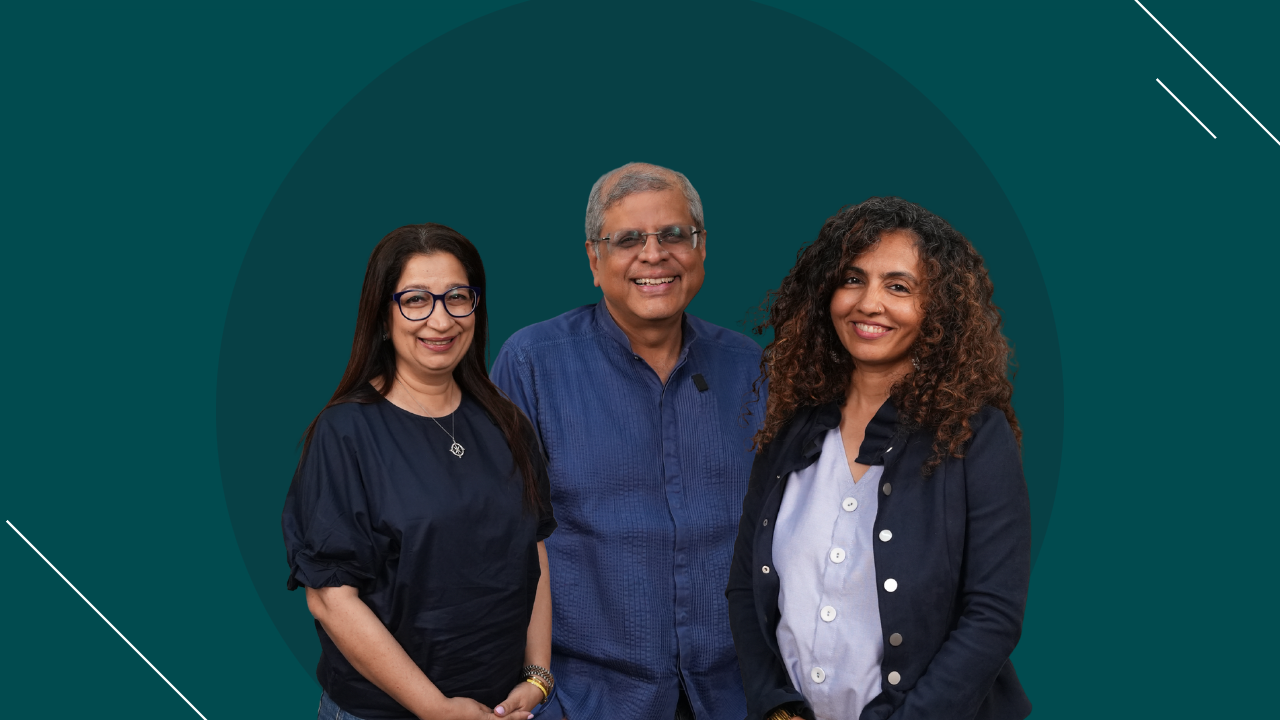



Key Takeaways:
- Strong institutions create lasting social impact. Through the A.T.E. Chandra Foundation's work in water security, agriculture, and capacity building, the Chandras have consistently focused on strengthening organisations rather than only funding projects.
- India needs capacity as much as capital. According to the India Philanthropy Report 2026, India's social sector funding has reached approximately Rs.27 lakh crore, yet an estimated Rs.16 lakh crore funding gap remains. Strong institutions are essential to ensure resources are translated into outcomes at scale.
- Real philanthropy is about making yourself redundant. The Chandras' long-term vision is not to build dependence on philanthropy, but to create systems, organisations, and communities that can eventually thrive without it.
"We're not looking to do the work ourselves." Mr. Amit Chandra's remark comes almost casually during the conversation. Yet it captures an idea that feels increasingly important in modern philanthropy.
Most people who give start by asking a fairly natural question: which problem should be solved? Mr. Amit and Ms. Archana Chandra seem to start somewhere else entirely — who is already solving this well, and how can that work be strengthened? It is a subtle shift in perspective. But it changes almost everything about where time, trust, and money end up going.
Philanthropy tends to celebrate what is visible. A school is inaugurated. A hospital wing opens. A water project transforms a village. These outcomes matter, and they are easy to communicate. What is much harder to see are the institutions behind them — the nonprofit leader who spent years earning a community's trust, the organisation that survived a funding drought nobody wrote about, the team that built systems, trained people, strengthened governance, and kept showing up, year after year, long after the cameras left.
Those stories rarely make headlines. They are often where the real impact lives. That belief sits at the centre of the A.T.E. Chandra Foundation's (ATECF) journey, whose work today spans water security, climate-resilient agriculture, disability inclusion, and nonprofit capacity building — priorities that, on the surface, look unrelated but share a common thread: the focus is not only on solving a problem today, but on building the capacity to keep solving it tomorrow.
Ms. Chandra explains it plainly: "We wanted to build an institute that would outlive an individual. How do you do that without capacity building?" Anyone who has worked in the social sector understands the weight of that question. Funding is routinely available for programmes, but rarely for leadership. Activities get funded; technology systems, governance structures, talent pipelines, and succession planning are treated as overheads rather than necessities — even though these are precisely what determine whether an organisation outlasts its founder. As Ms. Chandra puts it: "Unless you build an organisation or strengthen an institute, how are you going to continue doing what you're doing?"
That question is one philanthropy is increasingly being forced to confront, and not only in India. Research by the Center for Effective Philanthropy and Bridgespan has repeatedly shown that unrestricted, long-term support is what allows nonprofits to retain talent, strengthen systems, and respond to a crisis rather than merely survive it. The COVID-19 pandemic accelerated the lesson: many funders relaxed restrictions and gave nonprofits more room to decide where money was needed, and the organisations that received this flexibility performed better, not worse. Trust, it turned out, was not the risk. It was the accelerator.
The Chandras appear to have arrived at a similar conclusion through experience rather than theory. Rather than positioning themselves as problem-solvers, they increasingly describe themselves as enablers. Ms. Chandra recalls the instinct behind several of the Foundation's initiatives: "If I'm struggling, I'm sure there are so many more who are struggling. So what can we do about it as a foundation?" That question is a large part of why capacity building became such a serious bet for ATECF — not because it was fashionable, but because it was necessary.
Nowhere is that patience more visible than in the Foundation's water security work. India is home to nearly 18% of the world's population but has access to only about 4% of its freshwater, a gap that climate variability and groundwater depletion continue to widen. Over the past decade, ATECF's waterbody rejuvenation efforts have helped restore water security for more than a million villagers — not by building infrastructure and stepping away, but by creating models that communities, governments, and local NGOs could sustain on their own. "In water, we have now been doing it for 12 years," Mr. Chandra says. "We are just about gathering momentum after a decade of work. Hopefully, in another decade, our work will be done." There is something almost countercultural about a philanthropist measuring success by becoming unnecessary. He says it again, more directly: "We don't want to be relevant in 10 or 15 years." Few organisations say that. Fewer still mean it.
Institution building, in the Chandras' telling, is not solely a question of funding. Ms. Chandra reflects on how larger institutions actually take shape: "It doesn't only have to be about your resources or your time. It is also how you use your networks or your art of persuasion to get more people to come together and build larger and bigger institutes." That observation feels especially relevant as India's philanthropic ecosystem evolves. The India Philanthropy Report 2026 notes that family philanthropy is playing a growing role in addressing underfunded social challenges, even as the country's overall social sector funding — estimated at roughly Rs.27 lakh crore — still falls short of demand by close to Rs.16 lakh crore. More capital will help narrow that gap. It was never going to close it alone.
What stands out, ultimately, is not a programme or a funding figure but a mindset. The Chandras are not building organisations that depend on them forever; they are building ones strong enough to thrive without them. Projects end. Funding cycles end. Even philanthropists eventually step aside. Strong institutions are what remain — and perhaps that is the most meaningful legacy philanthropy can leave behind.
The full conversation is available to watch in the video accompanying this piece.