
Chairperson Vidya Shah's Letter - Annual Report 2025-26
The story almost always begins with a woman. And a crisis. Then comes a fortuitous meeting. One that sparks a chain reaction touching the lives of several women like her.



The story almost always begins with a woman. And a crisis.
Then comes a fortuitous meeting. One that sparks a chain reaction touching the lives of several women like her. They find community, and with that, we hope, a space for their voices to rise over the din of indifference.
It's a good story, told many times over in the development space. But what's often lost while adhering to a reporting template or the demands of an Instagram reel's brevity is the recognition of the slow, daunting, relentless work of building trust. Knocking on doors not knowing when they'd have the courage to open, stepping out in literal and metaphorical storms, showing up, staying put, losing your feet and finding them back again.
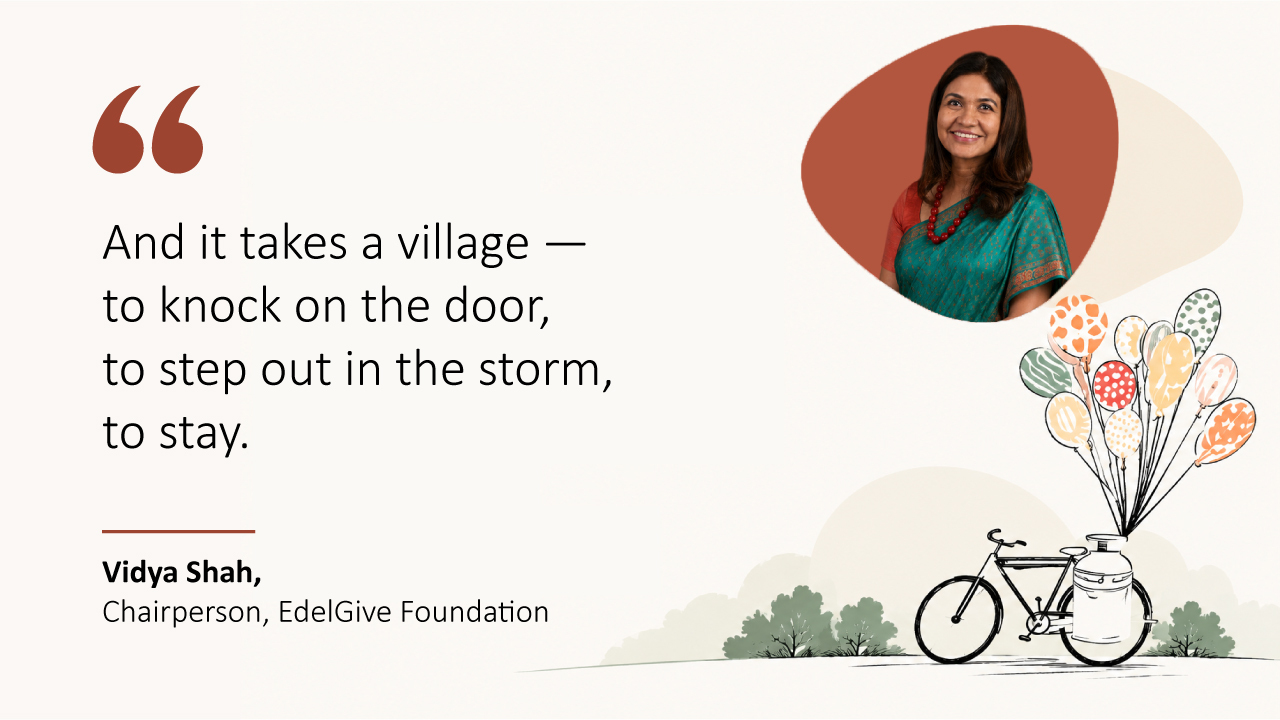
And it takes a village — to knock on the door, to step out in the storm, to stay.
EdelGive Foundation's work has always centered this proverbial village — the intricate network of people and institutions that make change possible — not as statistics, but as a living entity that hopes, hurts and often succeeds against many odds. But what does it take to make a village? I've learnt over the years, and from the best of our partners, it begins with knowing what to do with disappointments.
The most visceral are the ones that often come with new beginnings. The polite nods, the confused silences, the struggle to make everyone see what you see.
A partner non-profit that has done remarkable work with marginalised farmers across southern Indian states once, very lightly, told us how it takes days and sometimes months to start at even one village. When they arrived at a village now very central to their activities, for weeks no one spoke to them. The NGO could see the extreme climate stress farming was under, they offered solutions, and yet, they kept hitting a wall.
The organisation's representatives spoke the same language, carried the same cultural vocabulary. None of it mattered. What they didn't know then — what they would only learn by staying — was that the community had been badly defrauded in the past. So they kept showing up. Just for chai, conversations, to listen.
Then, they made an offer: to help restore a stream that had once watered dozens of acres and had long since fallen into ruin. Why would you do that? The villagers asked. Because this is our work, they said. Belief is a metric no one reports, yet it's perhaps the most important measure of the work we do. And it has taken many villages of grassroots activists and workers to grow and hold this patient knowledge of human fears, angst and scepticism. Investing in these systems of trust has been at the heart of EdelGive Foundation's interests.
I had read an interview of American novelist Toni Morrison, where she talks about her advice to her students, "When you get these jobs that you have been so brilliantly trained for, just remember that your real job is that if you are free, you need to free somebody else. If you have some power, then your job is to empower somebody else. This is not just a grab-bag candy game." I immediately thought about how our country's grassroots exist in this exact unspoken matrix of empathy — where strength moves freely, person to person, with no one keeping count.
In a world where knowledge and access are invaluable currency, often protected zealously by those who hold them, in some of the most marginalised communities it is like a communal gift — shared profusely, and with immense joy. And often, the architects of these structures of compassion are local non-profits.
Not only do they understand the contours of real and metaphorical villages — they can often tell who needs a new village.
Ten years ago, a non-profit we supported through Sandbox started building a coalition of single, rural women in Maharashtra. Widowed, unmarried, deserted or divorced women facing not just personal trauma but stigma and relentless attacks on their agency and rights, issues that rarely figure high on funding interest.
This did not deter the organisation, so they started — with just 32 women. A decade later, the coalition comprises 22,000 women and transwomen across eight districts, working towards entitlements, property rights, livelihood support and, at times, just a patient ear.
In a time when 'gender' has become a fierce, often violent battleground in digital spaces, the organisation started a kabaddi league for women and trans-women — underlining that building solidarities starts with something simple: respect for autonomy.
Along the way, we realised that these villages of solidarity need more than just recognition. Showing up costs, in cold, hard ways — and the GROW Fund was born from that understanding. It showed us how walking the talk on trust slowly earns its keep. GROW+ was built from that learning, to address climate change not as a project, but as a practice — building the foundations of organisations doing essential climate work. From the organisation that helps forest dwellers claim their legal rights to others who have completely re-invented caregiving by re-integrating elderly women into community decision-making, these are the villages it takes. GROW+ exists to make sure they don't carry that weight alone.
Behind the story you often read — a woman, a crisis and a meeting — is one that's rarely told as it should be.
Of a village, slowly, patiently, gathering around her, holding her and then becoming her.
Because, as Martin Luther King Jr. reminded us, human progress is never automatic—it comes only through the relentless effort of individuals committed to the cause. Without that commitment, the passage of time alone leads to stagnation rather than growth. As he put it, "We must use time creatively, in the knowledge that the time is always ripe to do right."
For EdelGive, that time is now. It always has been.
Vidya Shah
Chairperson, EdelGive Foundation